FOUNDATIONAL THESIS
In an information economy addicted to hyper-connectivity and endless notifications, shallow work dominates the corporate landscape.
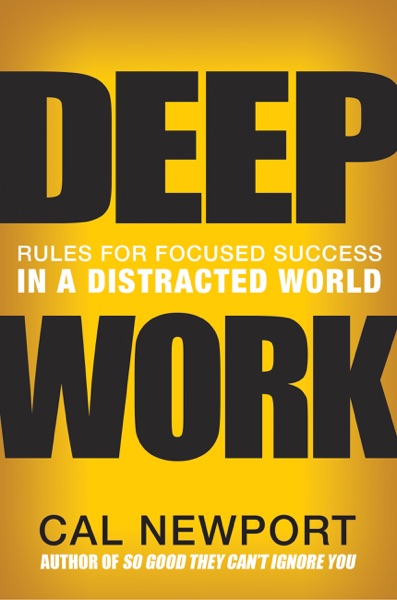
Cal Newport's Deep Work proves that the capacity for intense, distraction-free concentration is the superpower of the modern era.
Here is the operational framework to eliminate attention residue and produce work that cannot be replicated by algorithms.
The Deep Work Hypothesis
You spend your day responding to pings, checking inboxes, and reacting to urgent requests.
Deep Work is professional activities performed in a state of distraction-free concentration that push your cognitive capabilities to their limit. These efforts create new value, improve your skill, and are hard to replicate.
In contrast, Shallow Work consists of logistical, non-cognitively demanding tasks that are easily automated or outsourced.
To thrive in the modern economy, you must master two core abilities: quickly master hard things, and produce at an elite level.
Both require unbroken, high-density focus.
This is the High-Productivity Law: High-Quality Work Produced = (Time Spent) x (Intensity of Focus).
When your focus is splintered, your output drops exponentially regardless of the hours logged.
The Danger of Attention Residue
You think that taking a quick 15-second glance at Slack or email has no real cost.
When you switch from Task A to Task B, your attention does not immediately follow. A residue of your attention remains stuck thinking about the previous task.
Research proves that even if you spend only a few seconds checking an inbox, your cognitive performance on the primary task remains impaired for up to 25 minutes.
Constantly toggling between tasks keeps you in a state of permanent mental fog.
Protect your brain from attention residue:
- Never leave open communication channels while doing analytical or creative work.
- Batch all message processing into dedicated shallow work windows.
- Close browser tabs that are unrelated to your immediate deep objective.
- Treat unbroken focus as a precious biological resource.
Eliminating attention residue doubles your cognitive speed and accuracy.
Choose Your Deep Work Philosophy
Deep work does not happen spontaneously; it requires a deliberate structural philosophy.
You must choose a scheduling framework that matches your personality and professional constraints.
Newport outlines four distinct scheduling approaches:
- Monastic Philosophy: Eliminate all shallow obligations completely and isolate yourself for months (rarely possible for modern workers).
- Bimodal Philosophy: Divide your time into clearly separated periods of deep focus (e.g., 2–3 full days) and open logistical availability.
- Rhythmic Philosophy: Establish a daily, recurring ritual (e.g., 90 minutes of deep work every morning at 7:00 AM) like clockwork. 4. Journalistic Philosophy: Fit deep work into any unexpected gap in your daily schedule (requires seasoned cognitive discipline).
For most professionals, the Rhythmic approach creates the most durable long-term consistency.
The Grand Gesture & Environment Architecture
Sometimes changing your environment signals your brain that the stakes are high.
The Grand Gesture involves making a radical change to your normal environment, coupled with a significant investment of effort or money, to increase the perceived importance of the task.
J.K. Rowling checked into a luxury hotel to finish Harry Potter; Bill Gates retreated to a secluded cabin for Think Weeks.
Your physical surroundings dictate your mental focus.
Build your deep work ritual around clear environmental boundaries:
- Designate a specific desk, chair, or room dedicated exclusively to deep work.
- Clear all clutter, notifications, and secondary screens.
- Establish standard opening and closing rituals to transition in and out of deep focus.
- Stock all necessary research materials before starting so you never break flow.
A dedicated deep sanctuary programs your brain for rapid cognitive immersion.
Embrace Boredom & Train Your Focus Muscle
You believe that you can binge on distraction during downtime and still concentrate deeply when working.
The ability to concentrate intensely is a skill that must be trained. If you feed your brain novelty the moment you feel a second of boredom, you wire it to be addicted to distraction.
Every time you pull out your smartphone while waiting in an elevator or line, you reinforce a low-attention habit loop.
If you cannot tolerate boredom in leisure, you will never sustain focus on difficult problems.
Retrain your attention span with deliberate mental workouts:
- Schedule specific internet blocks rather than scheduling offline blocks.
- Practice productive meditation: focus on a single mathematical or business problem during walks.
- Embrace moments of standing in line without pulling out your phone.
- Set tight, aggressive countdown timers on complex analytical tasks.
Tolerance for boredom is the core foundation of superhuman focus.
Quit Social Media (The Craftsman Approach to Tools)
Most knowledge workers use tools like Twitter, LinkedIn, and endless news sites using the Any-Benefit Mindset.
The Any-Benefit Mindset assumes that if a tool offers any potential benefit, however small, it is justified. The Craftsman Approach demands that a tool must offer substantial, measurable advantages to your core goals.
The hidden cost of shallow network tools is not just time; it is the permanent fragmentation of your attention.
Network tools are designed by the best minds in behavioral psychology to hijack your dopamine and keep you shallow.
Audit your digital tool stack ruthlessly:
- Identify the core activities that generate 90% of your career and personal value.
- Put every social app and news feed on a 30-day voluntary ban.
- Only reinstall tools that proved indispensable to your primary mission.
- Replace mindless scrolling with high-quality, restorative offline leisure.
Rejecting shallow networks reclaims hours of uninterrupted creative bandwidth.
Drain the Shallows: Master Your Schedule
Most professionals spend 8 hours in an office and leave feeling exhausted despite accomplishing zero meaningful work.
Treat your workday with structured intentionality. Schedule every minute of your day in time blocks, assigning clear intentions to every hour.
Without an explicit plan, shallow tasks naturally fill the vacuum of your calendar.
Cap shallow work to a maximum of 30-50% of your total working hours.
Execute the shallow work drainage protocol:
- Implement strict Time-Block Scheduling every morning on paper.
- Quantify the depth of your tasks: 'How many months would it take to train a bright college graduate to do this?'
- Establish fixed-schedule productivity: set a firm hard stop at 5:30 PM every day.
- Require sender filters on incoming emails to eliminate low-effort requests.
Drawing firm boundaries around shallow obligations protects your deep creative runway.
The Shutdown Ritual & The Deep Life
You check work emails right before bed and wonder why you wake up mentally exhausted.
At the end of the workday, shut down your consideration of work issues completely until the next morning. No after-dinner email checks, no mental rehearsals.
Rest is not a luxury; it is the biological prerequisite for high-intensity cognitive output.
The capacity for deep work tops out at roughly 4 hours per day for even the most disciplined masters.
Execute a strict Daily Shutdown Ritual:
- Review your task list and calendar for tomorrow to ensure nothing is dropped.
- Record pending items into a trusted capture system.
- Say an explicit closing phrase out loud: 'Shutdown Complete.'
4.
Disconnect entirely from work communication until the next morning.
A complete evening shutdown restores the mental energy needed for tomorrow's deep sprint.
Deep Work's Hard Truth: It Asks More Than You Think
Millions of us dream of laser focus. We want to crush our to-do lists, create amazing things, and feel truly productive. Cal Newport promises a path to this powerful state, but can a book really cut through the constant noise of our modern lives?
When "Deep Work" first hit the shelves, many of us felt a surge of hope. Finally, a real answer to our scattered minds! We picked it up, eager to learn the secrets of true focus. The promise was clear: master deep work, and you'll stand out. You'll achieve more.
But then reality set in. The book lays out a demanding path. It's not just about trying harder. It's about fundamentally changing how you live and work. For busy managers, for working parents, for anyone without a completely flexible schedule, the vision of uninterrupted hours felt like a distant dream. "How can I do this with kids needing attention?" many wondered. "My boss expects instant replies!"
Yet, for those who leaned in, two powerful ideas truly stuck. First, the idea of scheduling deep work. Don't wait for focus to strike. Block out time. Treat it like a doctor's appointment. This simple shift helped countless people carve out precious hours. It works.
Second, the call to cut the digital noise. Turn off notifications. Log out of social media. This wasn't just advice; it was a challenge. And for many, taking that leap, even for short periods, proved incredibly freeing. It showed just how much our attention was being stolen. These breakthroughs, while tough, genuinely deliver results for those willing to commit.
The Honest Verdict
Read this if you have some control over your daily schedule and are serious about making significant changes to boost your focus and output.
Skip this if your job is highly interrupt-driven, you have very little flexibility, or you're looking for a gentle introduction to productivity.
Apply The 20% That Actually Works
Don't get bogged down in hundreds of pages. Master the full executive framework in 15 minutes, or open the 1-page action worksheet directly.
-
Offers practical, step-by-step methods for building good habits and breaking bad ones, which is crucial for sustaining deep work.
-
Provides a robust system for organizing tasks and commitments, clearing mental space so you can actually do deep work.
-
Focuses specifically on understanding and overcoming the psychological triggers of distraction, offering a more nuanced approach to managing your attention.
Executive Synthesis & Monday Morning Action
Deep work is not a moral obligation; it is an economic superpower.
By eliminating attention residue, adopting the rhythmic scheduling model, training your tolerance for boredom, and draining shallow tasks, you produce rare, irreplaceable value and live a deeply satisfying life.