FOUNDATIONAL THESIS
The modern efficiency obsession is built on a lie: the belief that with the right app or system, you can eventually conquer all demands.
Four Thousand Weeks destroys that illusion.
By accepting that your time is radically finite, you stop postponing your life for an impossible future of calm and start making bold, deliberate choices today.
The Absurd Finitude of Human Existence
You believe that one day you will finally catch up. You think that after one more productive sprint, you will finally have time for what matters.
If you live to be eighty, you have about four thousand weeks on Earth. That is all. It is not an infinite runway waiting for your perfection.
Traditional time management treats time as a container you must stuff with maximum output. That trap only accelerates your exhaustion.
Efficiency does not clear your plate; it generates more incoming volume.
When you answer emails faster, people send you more emails. When you become known as the most reliable person, you attract more complex problems.
This is the efficiency paradox: getting better at processing tasks guarantees you will never finish them.
True liberation begins when you accept that you will never do it all.
The Efficiency Trap and the Mirage of Calm
You treat time like an external resource you must manage, master, and use as an investment for the future.
When every activity is only justified by its future payoff, the present moment becomes nothing more than a toll booth you must pay to get somewhere else.
This turns your life into a perpetual rehearsal for a performance that never begins. You spend your finite weeks waiting for the conditions to be perfect.
The feeling of overwhelm is not a personal failure; it is the natural consequence of having infinite possibilities inside finite time.
To break out of the trap, you must practice radical subtraction:
- Acknowledge that you cannot clear the backlog of existence.
- Stop believing you have time for every interesting project.
- Let go of the fantasy that you will someday reach a state of zero stress.
- Recognize that missing out is not an error—it is the price of living.
Peace comes when you surrender the fantasy of total control.
Embrace Radical Limitation and Settle Deliberately
Modern culture teaches you to keep your options open. You fear settling down, committing to one career path, or closing open doors.
Keeping all doors open ensures you never fully walk through any of them. An uncommitted life is an empty life.
Every time you choose one path, you kill a thousand hypothetical alternatives. That is not a tragedy; it is what gives the chosen path its weight.
Meaning does not come from limitless optionality; it comes from radical commitment.
Choosing a partner, a craft, or a community requires saying a definitive 'no' to everything else:
- Settle purposefully into the constraints you have chosen.
- Stop daydreaming about alternative timelines you did not live.
- Appreciate that choosing creates the value, not the alternatives.
- Treat every limitation as a sharpening tool for focus.
When you stop running from commitment, you gain the depth that optionality can never give you.
The Art of Creative Neglect
Most productivity advice tells you how to prioritize. Very few systems teach you how to neglect.
Since you will inevitably leave things undone, the only question is whether you neglect them deliberately or by accident.
Creative neglect means making conscious, proactive choices about what you will do poorly or ignore entirely.
Strategic underachievement is the essential prerequisite for focused excellence.
Protect your top priorities by establishing hard limits on your capacity:
- Keep a strict 'open' and 'closed' task list with a hard cap of 3 active projects.
- Do not start a new project until an existing one is finished or abandoned.
- Decide which areas of your life will receive merely adequate effort.
- Resist the urge to clear the small tasks before tackling the deep work.
Nominate your areas of failure early so your vital goals receive your best energy.
Resist the Urge to Fill Every Void
You feel guilty whenever you are not productive. Even your hobbies are turned into side hustles or metrics to track.
True leisure must have no external purpose beyond itself. If an activity is only done for future benefit, it is not rest; it is work in disguise.
The ancient philosophers viewed rest not as a way to recharge for more labor, but as the ultimate goal of human life.
An activity done purely for its own sake is a powerful rebellion against factory time.
Reclaim your right to waste time meaningfully:
- Cultivate an 'atelic' hobby—an activity with no final finish line or commercial aim.
- Spend unstructured time walking, reading, or creating without sharing it online.
- Notice the urge to reach for a distraction the moment boredom appears.
- Allow yourself to sit quietly without solving any problems.
Rest is not a reward for finished work; it is an inherent right of mortal existence.
The Trap of Future-Oriented Living
You treat the present as an obstacle to be crossed on your way to a better future. You live in a state of deferred happiness.
The future you are preparing for does not exist; only the present moment has real substance. If you cannot live now, you will never live.
When you treat current activities purely as instruments for future security, you drain the present of all flavor and joy.
The future never arrives as the future; it always arrives as the immediate present.
Anchor yourself in the actuality of what is right in front of you:
- Recognize that this exact moment is not a stepping stone; it is your life.
- Bring your full attention to routine, daily actions rather than rushing past them.
- Accept that certainty about the future is an impossible illusion.
- Stop waiting for all problems to be resolved before enjoying your days.
When you stop bargaining with the future, the present moment reveals its true depth.
Cosmic Insignificance Therapy
You carry an unbearable pressure to make a massive dent in the universe. That grandiose ambition paralyzes your daily efforts.
On a cosmic scale, in a few hundred years, nobody will remember your mistakes, your projects, or your status. That is the greatest relief imaginable.
Cosmic Insignificance Therapy is not depressing nihilism; it is an exhilarating invitation to lower the stakes.
When your life is not a monument to be judged by eternity, you are free to do what is genuinely meaningful to you today.
Lower the bar from cosmic greatness to humble human presence:
- Measure your days by kindness, curiosity, and presence rather than world-changing metrics.
- Release the narcissistic demand that your life must transform history.
- Take bold creative risks because failure has no permanent cosmic penalty.
- Focus on solving real, local problems within your immediate reach.
Your smallness is not a tragedy; it is your permission slip to enjoy your finite four thousand weeks.
The Mortal Operating System and Immediate Action
Embracing your finitude is not about giving up; it is about choosing what matters and letting the rest burn.
Stop holding yourself to the impossible standard of an infinite being. You are a mortal with four thousand weeks.
Take your first concrete step into mortal clarity right now:
- Choose your single most important project and work on it for 30 minutes first thing tomorrow.
- Create a 'Closed List' with a maximum of 3 active tasks; all others go to a waiting list.
- Identify one domain where you will deliberately underachieve this week (e.g., spotless inbox, perfect lawn).
- Pick one hobby you enjoy purely for the doing, without tracking or monetizing it.
- When faced with a difficult choice, ask: 'Does this diminish me, or does it invite me to grow?'
You do not need more time. You only need to accept the time you actually have.
The Endless To-Do List Trap: Why "Four Thousand Weeks" Shakes Up Everything You Thought About Time
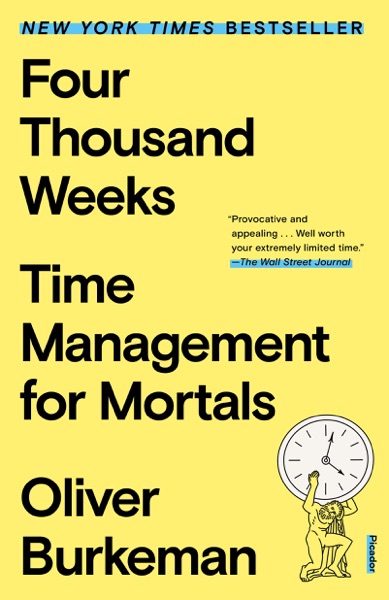
We all chase that feeling of being "on top of things." We buy planners, download apps, and read articles promising to unlock more hours in the day. But what if the whole game is rigged? What if trying harder just makes us feel worse? Oliver Burkeman's "Four Thousand Weeks" dares to say exactly that, challenging the very idea of time management.
Like many, I picked up "Four Thousand Weeks" hoping for the ultimate secret to getting everything done. I was tired of the endless to-do lists, the constant feeling of falling behind. The promise of finally "managing time" better felt like a lifeline.
But then the book hit me with a curveball. It said the whole idea of "time management" is a trap. It argued that our lives are short, finite, and we'll never get to everything. This was a tough pill to swallow. My initial reaction was, "Wait, what? So I just give up?"
The truth, though, started to sink in. The constant striving, the belief that I could get on top of it all, was actually making me more anxious. It was a treadmill I couldn't win. Burkeman's message wasn't about giving up, but about choosing what truly matters.
That's where the real breakthroughs emerged. The idea of "necessary neglect" was huge. It wasn't about failing to do things, but consciously deciding not to do them. And limiting my "work in progress" — focusing on one or two big things instead of ten small ones — brought a surprising calm. It didn't magically create more time, but it made the time I had feel more meaningful and less frantic. It's a hard book, but it changes your perspective.
The Honest Verdict
You're feeling overwhelmed by the endless pursuit of productivity and are ready for a radical shift in how you think about your limited time on Earth.
You're looking for quick-fix productivity hacks, detailed organizational systems, or a book that offers easy solutions to complex time management problems.
Apply The 20% That Actually Works
Don't get bogged down in hundreds of pages. Master the full executive framework in 15 minutes, or open the 1-page action worksheet directly.
-
Offers a more actionable framework for identifying and focusing on what is truly essential, complementing Burkeman's mindset shift with practical steps.
-
Provides a comprehensive, step-by-step system for organizing tasks and projects, perfect for those who need practical tools to manage their workload.
-
A foundational text for principle-centered living and time management, offering a broader perspective on personal effectiveness and long-term goals.
Executive Synthesis & Monday Morning Action
You have roughly four thousand weeks on this planet. Stop waiting for a magical day when you will finally conquer all incoming demands.
By accepting your human limitations, choosing what to neglect, and committing boldly to finite paths, you reclaim the profound joy and purpose of the present moment.