FOUNDATIONAL THESIS
Good is the ultimate enemy of great.
Most organizations fail to achieve enduring greatness not because of executive incompetence or poor market timing, but because they comfortably settle for being 'good enough.'
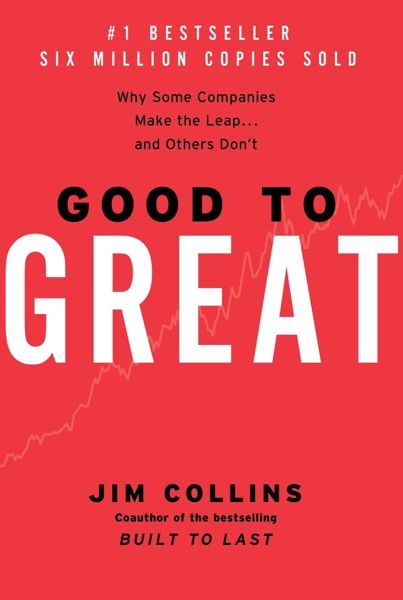
Through exhaustive five-year empirical research analyzing 1,435 companies over four decades, Jim Collins and his team unpacked why a select group of eleven companies made the leap from mediocre performers to sustained, world-class greatness.
The findings shatter conventional corporate mythology: greatness is not a function of flamboyant celebrity CEOs, high-risk acquisitions, or tech fads.
Instead, enduring greatness is achieved through a deliberate, methodical process of disciplined people, disciplined thought, and disciplined action.
Level 5 Leadership
The default cultural myth of corporate turnaround is that you need an egocentric, larger-than-life savior to ride in from the outside.
Level 5 leaders channel their ego needs away from themselves and into the larger goal of building a great company. Their ambition is first and foremost for the institution, not themselves.
We are conditioned by headlines to look for charismatic celebrities. But outsized ego is the enemy of enduring performance.
Every company that made the sustained leap to greatness was led by a Level 5 Leader—marrying extreme personal humility with intense professional will.
When success occurs, they look out the window to credit team members and good luck.
When setbacks happen, they look in the mirror and accept complete personal accountability.
Cultivate Level 5 Leadership through three core disciplines:
- Screen aggressively for the window-and-mirror mentality during all hiring.
- Strip away ego-inflating status perks that reward vanity metrics over durable value.
- Cultivate quiet resolve where teams perform self-reliantly when leaders leave the room.
When humility meets fierce resolve, excellence becomes an enduring institutional reflex.
First Who, Then What
Conventional wisdom dictates that you first formulate a brilliant vision and strategy, then recruit people to execute it.
If you begin with 'who' rather than 'what', you can more easily adapt to a fast-changing world. If people join for the destination, what happens if the destination changes?
Great-to-good leaders do the exact reverse: they first get the right people on the bus, get the wrong people off the bus, and put the right people in the right seats—and then figure out where to drive.
When you have high-caliber, disciplined individuals on board, the agonizing problem of how to motivate and micromanage them evaporates entirely.
Great people are inherently self-motivated by inner excellence and the camaraderie of exceptional peers.
Execute the 'First Who, Then What' principle with three strict guidelines:
- When in doubt, do not hire—keep looking until you find the exact right cultural fit.
- When you realize a team member is in the wrong seat, act decisively without delay.
- Put your absolute best talent on your biggest future opportunities, never on your biggest problems.
Superior talent density effortlessly navigates any unforeseen market disruption.
Confront the Brutal Facts: The Stockdale Paradox
Many organizations foster an environment of toxic positivity, where executives punish bad news and isolate themselves in corporate ivory towers.
You must never confuse faith that you will prevail in the end—which you can never afford to lose—with the discipline to confront the most brutal facts of your current reality.
Named after Admiral James Stockdale, the paradox explains how prisoners of war survived extreme adversity.
The optimists who set arbitrary calendar deadlines broke down; the survivors balanced unwavering faith with ruthless realism.
Retaining faith gives you the emotional resilience to push forward. Confronting brutal facts prevents you from steering the ship into an iceberg.
Institutionalize the Stockdale Paradox through four daily mechanisms:
- Lead with questions, not answers, in every operational review.
- Engage in passionate, fact-based debate without personal animosity.
- Conduct autopsies without blame when projects fail, extracting systemic lessons.
- Build red-flag mechanisms that instantly surface unfiltered customer and operational data.
Facing harsh truths head-on clears the path for decisive, reality-grounded breakthroughs.
The Hedgehog Concept
Most struggling companies suffer from strategic hyperactivity: chasing every shiny trend and trying to be everything to everyone.
The fox knows many things, but the hedgehog knows one big thing. Great companies distill complex reality into a single, crystal-clear organizing idea.
Greatness is not about complex, multi-tiered strategies.
The Hedgehog Concept sits precisely at the intersection of three vital circles: what you can be best in the world at, what drives your economic engine, and what you are deeply passionate about.
If an initiative does not fall directly inside all three circles, eliminate it immediately.
Apply the Hedgehog Concept using these rigorous filters:
- Define what you can genuinely be the best in the world at (and what you cannot).
- Identify your single economic denominator (e.g., profit per customer, profit per employee).
- Align your entire resource allocation around your core organizational passion.
- Build a strict 'Stop-Doing List' to defund projects outside the three circles.
Simplicity drives compounding power; focus on the single intersection that creates your unfair advantage.
A Culture of Discipline
As companies grow, they typically experience an explosion of bureaucratic overhead and micromanagement rulebooks.
Bureaucracy is meant to compensate for incompetence and lack of discipline—which you can avoid by getting the right people on the bus in the first place.
When you recruit disciplined people, you do not need hierarchy. When you foster disciplined thought, you do not need bureaucracy.
Great companies create a clear framework of core values and Hedgehog boundaries, then grant total freedom to operate within that framework.
Discipline is not about tyranny; it is about self-directed ownership of outcomes.
Establish a Culture of Discipline with these core practices:
- Build a rigorous 'Stop-Doing List' to systematically defund low-leverage distractions.
- Give team members full ownership and accountability for their domain outcomes.
- Treat Hedgehog boundaries as non-negotiable guardrails while encouraging experimental freedom within them.
- Reward consistency, meticulous attention to detail, and self-motivated execution.
A culture of discipline replaces soul-crushing bureaucracy with fast, empowered execution.
Technology Accelerators
In an era of rapid disruption, companies frequently succumb to tech FOMO, adopting shiny new tools in a desperate bid for growth.
Technology by itself is never the primary cause of greatness or decline. Technology is an accelerator of momentum, not a creator of it.
Great companies never adopt technology for the sake of novelty.
Pioneer the application of carefully selected technologies that directly accelerate your established Hedgehog Concept.
If a technology does not directly turn your economic flywheel, ignore it completely.
Evaluate technology investments using these three criteria:
- Never adopt technology to fix an unclear strategy or compensate for unmotivated personnel.
- Ask if the specific technology directly accelerates your single economic denominator.
- When a technology aligns with your flywheel, invest aggressively to become the benchmark in its utilization.
Treat technology as a high-powered amplifier, grounded firmly in your core business model.
The Flywheel Effect vs. The Doom Loop
From the outside, a successful corporate transformation looks like a sudden, miraculous flash of overnight brilliance.
No matter how dramatic the end result, good-to-great transformations never happen in one fell swoop. There was no single defining action, no silver bullet, no miraculous moment.
The reality of every great transformation is the Flywheel Effect.
Pushing a massive 15-ton metal disk moves it barely an inch; consistent, cumulative effort builds rotational momentum until the heavy disk spins with breathtaking self-sustaining power.
The Doom Loop is the exact opposite: erratic restructuring, constant rebranding, and jumping from one savior initiative to another without cumulative progress.
Build and protect your strategic flywheel:
- Map the exact 4-to-6 step compounding loop where each success directly feeds the next.
- Measure and celebrate incremental flywheel turns so the team visually experiences momentum.
- Eliminate erratic strategic shifts that abruptly brake or reverse the existing wheel.
- Maintain relentless consistency in the boring, high-leverage daily routines.
Breakthroughs are the compound accumulation of thousands of consistent, disciplined pushes.
From Good to Great to Built to Last
Once an organization establishes a spinning flywheel, it faces its greatest vulnerability: institutional complacency and hubris.
Enduring greatness requires mastering the duality of preserving the core and stimulating progress. Core values never change; operating practices constantly evolve.
Great institutions have an immutable core ideology—a purpose beyond just making money.
Simultaneously, they maintain an insatiable appetite for change, bold experimentation, and aggressive adaptation in all operational strategies.
Never confuse timeless core values with temporary operating practices.
Institutionalize longevity with three foundational practices:
- Articulate 3 to 5 core values you would uphold even if the market penalized you.
- Set audacious Big Hairy Audacious Goals (BHAGs) that stretch your team within your Hedgehog Concept.
- Continually evolve products, tools, and structures while treating your foundational purpose as untouchable bedrock.
Enduring greatness combines unshakeable core principles with relentless forward innovation.
The 'Good Enough' Trap: Why Jim Collins' Masterpiece Still Haunts Millions
Every business leader, every ambitious professional, dreams of taking their company from 'good' to 'great.' Jim Collins promises a roadmap. But after millions of copies sold, why do so many organizations still struggle to make that leap? Is the secret sauce really within reach for everyone?
You pick up 'Good to Great' with high hopes. You want your company to be amazing. Collins promises a clear path. You start reading. The research is impressive. But then you hit the 'Level 5 Leader' and 'First Who' concepts. You look around your office. Can my boss be a Level 5? Can we really fire half the team? The initial excitement fades. It feels like a massive undertaking. It's not about a new marketing plan or a better app. It's about changing the very DNA of your organization. This is where millions of readers get stuck. But then, you focus on 'First Who, Then What.' You realize even small teams can apply this. Getting the right people, even just one or two, can change everything. It's about talent, not just tasks. And the Hedgehog Concept. It forces you to simplify. What are we truly great at? What do we love? What makes money? This clarity, even for a personal project or a small department, cuts through the noise. It's powerful. So, while the full leap to 'great' might seem out of reach, these core ideas are like sturdy anchors. They give you a starting point, a way to build something truly special, one right person and one clear focus at a time.
The Honest Verdict
Read this if you are a senior leader, an aspiring executive, or part of a company genuinely committed to a long-term, fundamental transformation.
Skip this if you're looking for quick fixes, tactical advice for a small team, or don't have the authority to drive significant organizational change.
Apply The 20% That Actually Works
Don't get bogged down in hundreds of pages. Master the full executive framework in 15 minutes, or open the 1-page action worksheet directly.
-
Collins' earlier work, exploring enduring companies and their core values, offering a foundational perspective.
-
More accessible for individuals and teams seeking purpose-driven leadership and motivation.
-
Practical guide for small business owners on building systems and scaling, addressing common pitfalls.
Executive Synthesis & Monday Morning Action
Enduring greatness is not an elusive mystery reserved for lucky corporate titans; it is the predictable result of applying timeless, empirical disciplines with unrelenting consistency.
By coupling Level 5 humility with ferocious resolve, assembling extraordinary people before fixing direction, and confronting brutal facts without losing faith, you build the foundation for transformation.
When you align strictly around your Hedgehog Concept, foster a culture of discipline, and relentlessly push your compounding flywheel, you transcend mediocrity and build an enterprise built to last.